Typical tendencies
Energy level
Ready to go when you are, settles after.
Good with children
Patient with kids when well supervised.
Good with other dogs
Selective; careful introductions needed.
Trainability
Quick to learn and keen to please.
Shedding
Noticeable, with heavier seasonal blows.
Apartment friendly
Can manage in a flat with plenty of outings.
More traits
Exercise needs
Adaptability
Grooming needs
Drooling
Intelligence
Family friendly
Good with cats
Friendly with strangers
Sociability
Protectiveness
Prey drive
Overview
The Rottweiler is a powerful, confident working dog that is calm and deeply affectionate with its own family and serious about protecting it. It suits experienced owners who want a steady companion for training, hiking and guarding, who can offer firm, kind leadership and plenty of structure, and who do not mind a dog that leans 100 pounds of love against their legs. A well-bred, well-socialized Rottweiler is gentle with its children, patient and surprisingly clownish at home. The breed is wrong for people who want a dog friendly with everyone, who are away all day or who cannot commit to training a large, strong animal from puppyhood. Buy from a breeder who screens hips, elbows, eyes, heart and the JLPP gene and proves temperament, or adopt an adult whose character is known, and expect to invest in socialization for the dog's whole life.
History & Origin
The Rottweiler is one of the oldest German breeds, descended from the drover dogs that marched with Roman legions over the Alps, herding the cattle that fed the army and guarding the camps. Around the town that became Rottweil, in what is now Baden-Württemberg, these dogs mixed with local stock and settled into centuries of work for butchers and cattle dealers: driving herds to market, pulling meat carts and guarding the proceeds. The nickname Rottweiler Metzgerhund, the butcher's dog of Rottweil, stuck, and legend says drovers tied their purses around the dog's neck for safekeeping. When railways replaced cattle drives in the 1800s the breed nearly disappeared; a show in Heilbronn in 1882 drew a single poor specimen. Police trials revived it, with official recognition as a police dog in 1910. German breed clubs formed in the early 1900s and merged in 1921 into the Allgemeiner Deutscher Rottweiler-Klub, still the breed's home club. The AKC recognized the Rottweiler in 1931.
Appearance
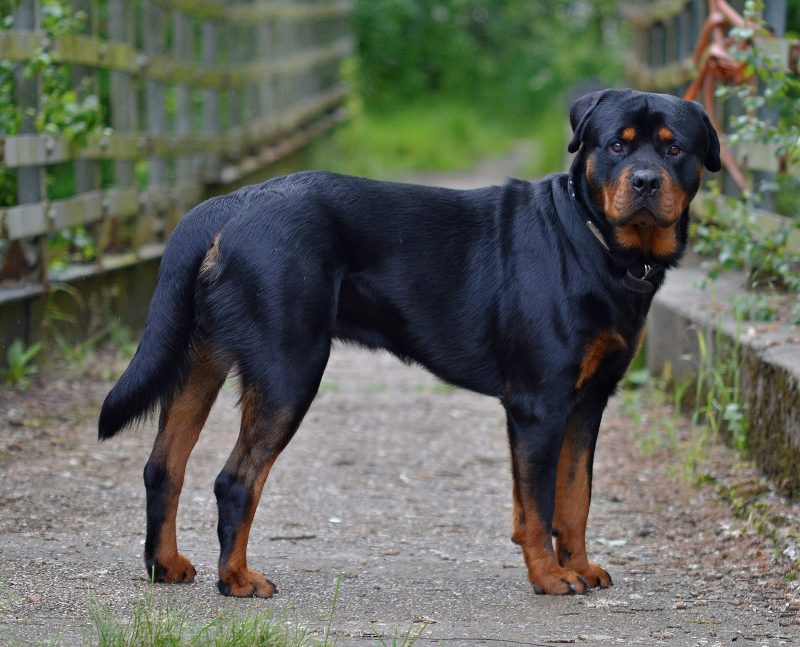
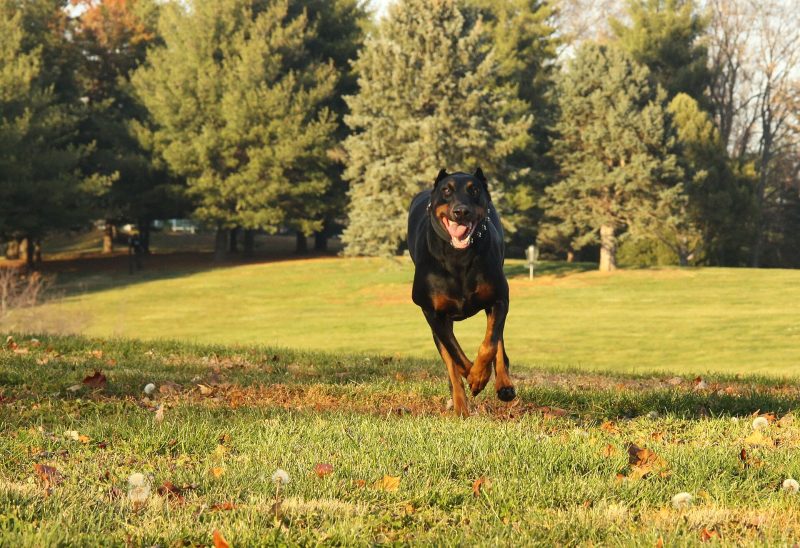
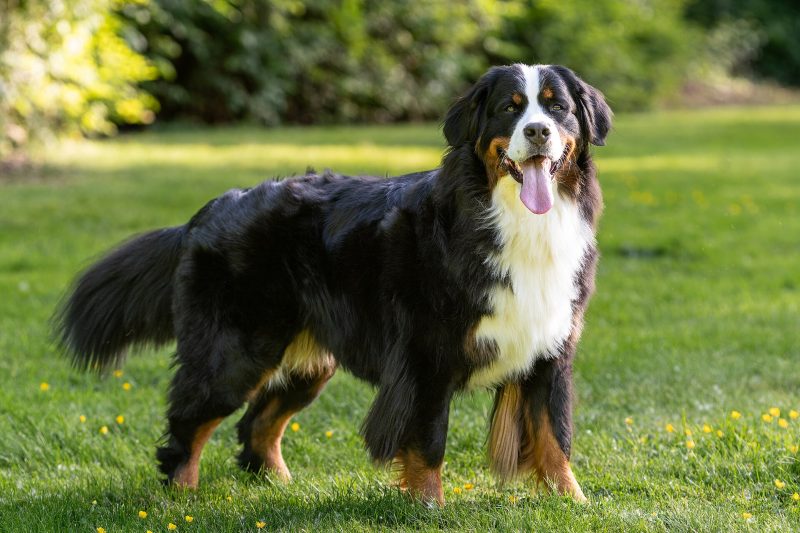
A Rottweiler is a large, robust, slightly longer-than-tall dog with a broad chest, heavy bone and an unmistakable air of strength. Males stand 24 to 27 inches and weigh 95 to 135 pounds; females are 22 to 25 inches and 80 to 100 pounds. The head is broad with a well-defined stop, a strong muzzle, medium-sized triangular ears that lie flat against the head and dark, almond-shaped eyes with a calm expression. The coat is short, coarse and dense with an undercoat on the neck and thighs, always black with clearly defined markings in rust, tan or mahogany over the eyes, on the cheeks, muzzle, chest and legs and under the tail. Tails were traditionally docked in the United States and are left natural in most of Europe. Next to a Doberman the Rottweiler is heavier and broader with a shorter muzzle; next to a Bernese Mountain Dog it is short-coated and lacks white markings.
Temperament & Personality
The breed standard calls for a calm, confident and courageous dog with a self-assured aloofness that does not lend itself to immediate friendships, and that describes a good Rottweiler well. At home they are affectionate, often goofy, and inclined to follow their person from room to room and lean on them. With strangers they are watchful and reserved, warming up once the owner signals that all is well. They are natural guardians who assess rather than react, and they rarely bark without reason. Energy is moderate: a Rottweiler enjoys work and play but settles readily indoors. They are generally good with children in their own family, though their size and the herding habit of bumping call for supervision with small kids. Same-sex aggression toward other dogs is not uncommon, and cats and small pets are safest when the dog is raised with them. Poorly bred or unsocialized Rottweilers can be fearful or aggressive, the opposite of the breed's steady ideal.
Exercise & Activity
An adult Rottweiler needs about an hour to 90 minutes of exercise a day, combining brisk walks or hikes with play and training. They are strong rather than fast, and they love carting, weight-pull, herding, tracking, obedience, rally and protection sports, all of which give the working brain a job. Swimming is good low-impact exercise for a heavy dog. Puppies should not jog, jump or climb stairs repeatedly until the growth plates close at about 18 to 24 months, since the breed's joints are vulnerable. Rottweilers enjoy cold weather and overheat easily in hot weather because of their mass and dark coat, so summer exercise belongs in the early morning or evening with water on hand. Mental work matters as much as mileage. An under-exercised Rottweiler becomes restless, destructive and more reactive to passers-by.
Daily: a long walk plus 15–20 minutes of training or play
Weekly: a working activity such as tracking, carting or a class
Training
Rottweilers are intelligent, eager workers that excel in obedience, tracking, herding, carting and police and service roles. They learn quickly and want to please the people they respect, which makes training rewarding, but they also test boundaries, especially in adolescence, and a dog this strong must have reliable manners before it reaches full size. Begin socialization immediately and continue it for life: introduce the puppy to people of all ages and appearances, well-mannered dogs, traffic, handling and new places, so that the breed's natural reserve stays calm rather than tipping into suspicion. Use reward-based training with food, toys and praise; harsh methods create a defensive dog. Priorities are loose-leash walking, a solid stay, calm greetings and a reliable 'leave it' and recall. Watch for resource guarding and address it early with trading games. Group classes are valuable for both the training and the exposure. A trained Rottweiler is a credit to the breed; an untrained one is a liability.
Grooming & Care
Rottweiler grooming is easy. The short double coat needs a weekly brush with a rubber curry or bristle brush to lift loose hair and distribute skin oils, and more frequent brushing in spring and fall when the undercoat sheds. Shedding is moderate but constant, and the black hairs show on light floors. Bathe every couple of months or when the dog has rolled in something. Check the drop ears weekly for wax or odor and clean when needed. Nails are thick and grow fast; trim every three to four weeks, starting in puppyhood so the dog accepts it, because an adult Rottweiler that objects to nail trims is a problem. Brush teeth several times a week. Check the skin for lumps during brushing, since the breed is prone to several cancers, and look at the eyes for redness or discharge, which can signal entropion or ectropion.
Brush: weekly, more during seasonal shedding
Nails: every 3–4 weeks
Teeth: several times weekly
Health
Rottweilers live about 9 to 10 years on average. Orthopedic disease is the biggest category: hip and elbow dysplasia, osteochondritis dissecans in growing dogs and cranial cruciate ligament rupture in adults, all worsened by excess weight. Osteosarcoma, an aggressive bone cancer, is markedly over-represented, and lymphoma and other cancers are common. Subaortic stenosis and dilated cardiomyopathy are the main heart conditions. The deep chest brings bloat risk. Eye problems include entropion, ectropion and progressive retinal atrophy. Two inherited neurological diseases have DNA tests: juvenile laryngeal paralysis and polyneuropathy (JLPP), which is fatal in puppies, and leukoencephalomyelopathy (LEMP). Hypothyroidism and allergies also appear. The American Rottweiler Club requires breeding stock to have OFA hip and elbow evaluations, an eye exam by a veterinary ophthalmologist, a cardiac exam and JLPP clearance by DNA test or parentage; ask to see the results. See your vet for lameness that lasts more than a day or two, a hard swollen belly, exercise intolerance or any swelling on a limb.
Nutrition
A Rottweiler puppy can gain several pounds a week, and feeding for slow, steady growth protects the joints. Use a large-breed puppy formula with controlled calcium and calories until 12 to 18 months and switch to adult food on your vet's advice; do not add calcium supplements. Adults need portions matched to work and metabolism, which vary widely in this breed, and should be kept lean, with ribs easy to feel and a visible waist, because extra weight accelerates joint disease. Feed two meals a day rather than one, avoid vigorous exercise for an hour before and after meals and use a slow-feeder bowl for gulpers, all to reduce bloat risk; ask your vet about a preventive gastropexy during spaying or neutering. Rottweilers are often food-motivated, which helps training but means treats must be counted. Joint supplements are commonly discussed for the breed; check with your vet before adding any. Keep fresh water available.
Living With This Breed
A Rottweiler belongs in a house with a securely fenced yard and a family that is home much of the day. Apartments are possible for dedicated owners, but the breed's size and guarding instincts make close quarters harder. They dislike long solitary days and are happiest as full members of the household. Most are devoted to their own children and polite with other people's once introduced. Some homeowner insurance policies and rental agreements exclude the breed, so check before committing. Hot climates need care. For sitters and daycare staff: meet the dog with the owner present, let it approach you, keep routines consistent, avoid off-leash contact with unfamiliar dogs, and remember that a guarding breed may react differently to a stranger entering the home when the family is away.
Introduce yourself formally before the first solo visit
Watch group play; Rottweilers body-check and can be same-sex intolerant
Keep a cool, calm manner; the dog takes cues from you
Interesting Facts
Rottweil was a Roman settlement called Arae Flaviae, and the dogs that drove cattle for the legions are the breed's claimed ancestors, which makes the Rottweiler one of the oldest working breeds in Europe.
Medieval butchers reportedly tied their purses around their Rottweilers' necks on the way home from market, trusting the dog more than any strongbox.
The breed came within a whisker of extinction after railways replaced cattle drives; a show in Heilbronn in 1882 drew a single entry.
Rottweilers were among the first breeds officially adopted for police work in Germany, in 1910, and served as messenger and guard dogs in both world wars.
In the mid-1990s the Rottweiler briefly ranked as the second most popular breed in the United States.
The children's picture books about Carl, a Rottweiler who babysits a toddler, have sold millions of copies and done more for the breed's image than any campaign.
Breeds similar to the Rottweiler
What Rottweiler owners say
Real pets, photos, stories and tips from the SitterNation community — separate from the editorial guide above.
Log in to add your pet, photos, stories and tips.
Meet Rottweilers on SitterNation
No Rottweilers have joined yet. Owners can show their pet here from the pet's profile.
Rottweiler community photos
No Rottweilers photos yet — be the first to share one.
Stories from Rottweiler owners
No stories yet. What is life with yours really like?
Tips from Rottweiler owners
No tips yet. One practical thing that works for you is enough.
Ask Rottweiler owners
No questions yet. Ask the people who live with the breed.